
Tag Archives: Governance

Enterprise AI Adoption Roadmap: Preparing Your Business for Agentic AI

AI Strategy

Introducing AI agents into an organization is not simply a software procurement decision. An agent that can retrieve information, make recommendations, and take actions may change who performs a task, who approves it, and how failures are detected. The real work begins before deployment: understanding existing processes, improving their design, and determining where autonomy is justified.

Microsoft’s 2025 Work Trend Index describes a progression from AI assistance to agents executing tasks under human direction and, eventually, more extensive process automation. It also emphasizes that organizations may occupy multiple stages at once. Businesses should treat this as a framework for planning, not a timetable they must follow. The following eight stages provide a practical path from initial evaluation to controlled deployment and long-term adoption.

1. Establish the Business Case Before Choosing Tools

Begin with a business outcome: shorter customer response times, faster processing of routine requests, fewer manual handoffs, or improved accuracy. Document the current process, its volume, cost, delays, and failure points. Without a baseline, teams may celebrate the number of tasks an agent completes without knowing whether the overall operation improved.

Separate opportunities that need content generation, conventional rules-based automation, and truly agentic decision-making. A predictable data transfer may be better handled by an existing integration. Agents make more sense when tasks involve varied inputs, contextual interpretation, or choosing among permitted actions. Use the least autonomy required to achieve the result.

2. Map the Workflow as It Actually Operates

AI Workflow

Process diagrams often show the intended sequence rather than the exceptions employees navigate every day. Interview the people doing the work and trace real examples from request to resolution. Identify the source of each input, the systems involved, handoffs, rework, approvals, and informal workarounds.

Pay particular attention to where human judgment adds value. A service team may apply a policy automatically to routine requests but escalate disputes or unusual account histories. Those exception paths are part of the workflow, not edge cases to discover after launch.

3. Redesign the Process Before Automating It

Automating a fragmented process can make its weaknesses move faster. Before adding agents, remove duplicate approvals, clarify ownership, standardize data fields, and eliminate steps that exist only because systems do not communicate. Define a clean handoff between people, software rules, and AI assistance.

Consider a purchasing department where employees receive requests by email, copy details into a spreadsheet, and enter approved purchases into an ERP system. Before introducing AI, the organization establishes one authoritative request record, standardized data fields, and clear approval thresholds. An authorized agent can then check incoming requests for missing details, consult purchasing policies, and prepare recommendations. Employees remain responsible for approving spending. Redesigning the process first removes avoidable handoffs and clarifies accountability before introducing autonomy.

This stage is often where the largest organizational questions emerge: Who owns an exception? What happens when an agent is uncertain? Which actions require approval? If those questions have no clear answers for employees, an automated system will not resolve them reliably.

4. Assess Data, Integration, and Security Readiness

Once a workflow is redesigned, the next question is whether the existing technical environment can support it reliably. Agents need dependable access to the information and systems necessary for their tasks. Review data quality, permissions, ownership, API availability, and whether business rules are documented. Evaluate how integrations behave when a service is unavailable, records conflict, or a request is retried. Systems that update operational data need safeguards against duplicate actions, traceable logs, and procedures for detecting and correcting failures. Inconsistent records or policies can undermine an otherwise capable model.

Treat access as a design decision. Start with read-only capabilities where possible, and grant write permissions only for explicitly approved operations. Use scoped credentials, logging, transaction limits, and confirmation before irreversible actions. The NIST AI Risk Management Framework provides a useful structure for considering governance, measurement, and risk management alongside deployment.

Also establish what information may be processed by external AI services, which tools employees may use, and how sensitive outputs are handled. An approved path for experimentation helps reduce the incentive for unmanaged shadow AI without assuming that policy alone prevents it.

5. Design Human Oversight Into the Workflow

Human Oversight in AI

The goal is not to remove people indiscriminately. Assign a business owner to each automated process and define the agent’s authority in operational terms: what it may read, draft, recommend, create, update, or send. For decisions involving payments, legal commitments, account access, or material customer impact, determine where a human checkpoint is required.

Oversight should be useful rather than ceremonial. Reviewers need the source information, the proposed action, reasons for escalation, and an easy way to reject or correct an output. Document who can disable the agent, how incidents are reported, and how a process returns to manual operation.

6. Pilot One Bounded Workflow and Measure Outcomes

Choose an initial workflow with sufficient volume to measure, manageable risk, clear data access, and an accountable team. Build a representative evaluation set that includes standard cases, incomplete information, conflicts, and failed integrations. Test the complete sequence of retrieval, reasoning, tool use, review, and downstream updates.

Before launching a pilot, establish measurable acceptance criteria and conditions that would prevent wider deployment. Measure completion rate, cycle time, error and escalation rates, reviewer effort, cost per completed task, and effects on customers or employees against the original baseline. For example, a customer-support workflow may need accurate policy interpretation, reliable escalation of unusual cases, and lower total resolution time. A solution that completes more requests but increases complaints or correction costs should not be considered successful.

Use gradual rollout with monitoring, permissions appropriate to each stage, and a rollback procedure. Where agents can change business records, confirm that failed operations can be detected and reconciled. Pilot success should mean the process operates reliably, not simply that the demonstration worked.

7. Prepare Teams for New Responsibilities

Employees need practical training in supervising AI-assisted work: verifying outputs, recognizing uncertain results, handling exceptions, and knowing when to bypass the system. Managers need to redesign performance expectations as responsibilities shift from producing routine work toward checking outcomes and resolving complex cases.

Invite employees into workflow design rather than announcing a finished tool. They often know the undocumented rules, customer sensitivities, and failure conditions that a project team misses. Give teams a channel to report problems and propose improvements. Adoption depends on trust that concerns will lead to visible corrections.

8. Scale Through Reusable Standards, Not Isolated Experiments

After a successful pilot, document its integrations, evaluation tests, access controls, failure procedures, operating costs, and owner. Create reusable standards for new workflows, including approval thresholds and change management. Reassess controls whenever an agent receives a new capability or permission.

Expand to adjacent processes only when data quality, integration reliability, and support capacity can sustain the workload. Not every department requires the same model, tool, or degree of autonomy. A portfolio of narrowly scoped assistants and agents may be safer and easier to maintain than one system expected to manage everything.

Build an Adoption Roadmap Around Operational Readiness

A roadmap becomes actionable when each phase produces a clear deliverable. The following checklist summarizes the evidence teams should have before expanding the scope of automation.

Roadmap stage Expected deliverable
1. Business case Defined objective and baseline metrics
2. Workflow mapping Documented handoffs, exceptions, dependencies
3. Process redesign Simplified workflow and clear ownership
4. Readiness assessment Data and security readiness
5. Human oversight Approvals, escalation, ownership
6. Pilot and measurement Evaluation results against acceptance criteria
7. Employee preparation Training plan and feedback process
8. Responsible scaling Reusable operating standards

Successful enterprise AI adoption depends on redesigned workflows, clear accountability, and evidence of operational value. The goal is a dependable operating model in which employees, conventional software, and AI systems each handle the work they are best equipped to perform.

Related reading: Which AI Software Is Right for Your Business? An In-Depth Look

Key Benefits of Generative AI in Business

Generative AI for BusinessGenerative AI has moved beyond experimentation. Businesses are using it to draft materials, interpret information, accelerate development, and make specialized knowledge easier to access. The challenge is no longer finding something AI can do. It is identifying work where AI makes a measurable difference.

A useful AI strategy starts with the work itself: who performs it, what slows it down, what quality standards matter, and what happens when the output is wrong. Without that discipline, organizations risk accumulating tools and demonstrations that never become dependable parts of daily operations.

Where Generative AI Fits into Business Operations

Generative AI is particularly suited to information-heavy work involving drafting, summarizing, classification, translation, analysis, and code generation. These activities appear across departments, but the best implementations address a specific workflow rather than applying the same assistant to every task.

Marketing and Communications

Marketing teams can develop early campaign concepts, adapt copy for different channels, analyze customer feedback, and prepare content briefs. AI is most useful here as an accelerator of research and production, not an independent source of brand strategy. Human review remains essential for originality, accuracy, claims, and tone.

Customer Support and Internal Knowledge

Support representatives can use AI to find relevant knowledge-base material, summarize long conversations, and draft responses. For example, a software support team could connect an assistant to an approved knowledge base so it can retrieve troubleshooting steps and prepare responses for employees to verify before sending. Other departments can similarly use AI to search policies, manuals, and project documentation. In every case, the benefit depends on current, accessible information and clear links to trustworthy sources.

Software Development and Product Teams

Developers can generate initial code, documentation, test suggestions, and explanations of existing systems. Product teams can organize requirements and explore prototype concepts. These tools can reduce repetitive work, but architectural design, code reviews, security, and release decisions remain engineering responsibilities.

Research, Finance, and Administration

AI can summarize lengthy reports, compare supplied documents, help organize meeting notes, and prepare preliminary analyses. In financial and operational work, generated explanations should be checked against authoritative records. A fluent summary is not evidence that the underlying numbers or conclusions are correct.

The Benefits That Matter Most

Gen AI Benefits

Speed is an obvious attraction, but speed alone is a weak success metric. If a draft takes five minutes to generate and thirty minutes to correct, the business case changes. The useful measure is the effort required to produce an acceptable final result—and whether that improvement reduces delays across the complete workflow. Faster drafting creates little value when downstream approvals remain the bottleneck.

There is evidence of meaningful gains in certain environments. A study by Erik Brynjolfsson, Danielle Li, and Lindsey Raymond examined a generative AI assistant introduced to customer support agents. The researchers reported an average productivity increase of about 14%, measured by issues resolved per hour, with larger gains among less experienced workers. That finding is specific to the studied workplace and should not be treated as a universal productivity forecast.

Generative AI may also help organizations make expertise more accessible. A new employee can obtain explanations of unfamiliar procedures, while an experienced specialist can spend less time producing routine documentation. These benefits are strongest when the system draws on accurate information and employees know when to challenge its output.

Another opportunity is consistency. Shared templates and approved reference materials can help teams maintain terminology, documentation standards, and communication practices. But consistency should not be confused with correctness: a system can repeat the same mistake reliably.

Where Generative AI Falls Short

Generative models can produce confident but incorrect claims, invented references, incomplete analysis, and code with subtle defects. Their outputs may vary with prompting, context, and model changes. These limitations matter most when the resulting content informs financial, legal, technical, or customer-facing decisions.

Data handling deserves equal attention. Employees may enter confidential documents, customer records, or proprietary code into tools without understanding retention, access, or contractual controls. Organizations need approved environments, clear usage rules, and appropriate data restrictions before sensitive workflows are introduced.

The NIST Generative AI Profile identifies risks including confabulation, privacy issues, and other potential harms. Those categories provide a useful basis for evaluating where verification, access controls, documentation, and human oversight are required.

How to Identify High-Value Opportunities

The strongest starting points are often frequent, time-consuming tasks with clear quality criteria and manageable consequences when AI makes an error. Examples include preparing internal summaries, organizing research, creating first drafts, or assisting with noncritical documentation.

Rather than asking each department to suggest AI ideas, map one existing process from input to approved output. Record how long it takes, where handoffs occur, what information is needed, and how errors are caught. This exposes the difference between a task that feels repetitive and one that can safely be improved with AI.

Then distinguish three options. A standalone assistant may suffice when employees need occasional help drafting or summarizing. AI embedded in an existing business application fits recurring work already managed there. A custom system is more appropriate when tasks depend on proprietary data, specialized workflows, or controls unavailable in standard tools. The added flexibility also brings maintenance, integration, and security obligations.

Implementation: People, Data, and Process

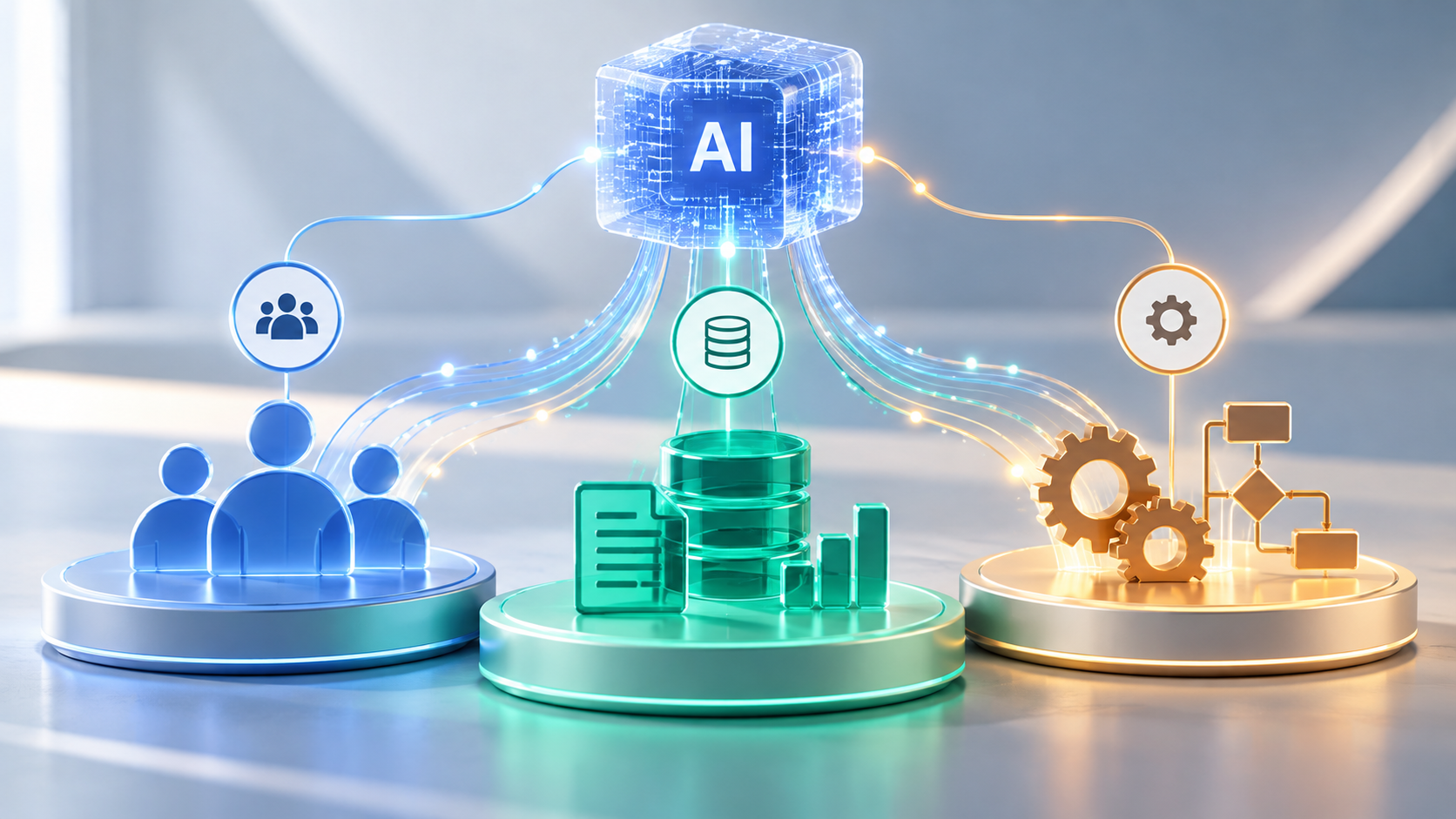
AI for People, Data, and Processes

Start with a bounded pilot that has a responsible owner, a documented use case, and a clear definition of success. Select representative examples, including difficult cases, rather than evaluating the tool only on ideal inputs. Establish what employees should verify and when they should stop using an output.

Next, decide which information the system may access. Public material may need little additional integration, while internal knowledge may require retrieval-augmented generation (RAG). This approach retrieves relevant documents and supplies them as context to the language model rather than relying solely on its training. Effective RAG still depends on accurate sources, reliable retrieval, permission-aware access, and testing. Information access should reflect actual business needs rather than being granted by default. In practice, dependable source data, integration design, and validation can matter more to an application’s usefulness than the model’s standalone capabilities.

Employee training is part of implementation, not an optional follow-up. Teams need to recognize unsupported assertions, protect confidential information, review outputs, and report recurring errors. Managers should also make the purpose of the tool clear: which work it should improve and which decisions still belong to people.

Finally, choose the simplest technical approach that meets the requirement. A supported business application may be sufficient for document drafting. A specialized internal knowledge assistant may require integrations. A custom solution makes sense when workflows, data controls, or user experience cannot be accommodated effectively by existing tools.

Measure Results Before Scaling

Compare pilot outcomes against a baseline established before deployment. Useful measures include end-to-end task time, accepted-output rate, correction effort, error frequency, user adoption, and total operating cost. For example, a team might compare the time required to draft, verify, and approve technical reports before and after introducing AI. Faster drafts deliver little value if corrections consume the time saved. For customer-facing applications, monitor service quality rather than assuming faster responses automatically mean better experiences.

Include the hidden costs: subscriptions or usage fees, integration work, training, security review, monitoring, and ongoing changes. A pilot that saves time for one employee may still be uneconomical if the wider process requires extensive review or frequent troubleshooting.

Expand only after the results justify it. Successful examples can become repeatable workflows with documentation, ownership, and periodic evaluation. Failed pilots are still useful when they reveal poor source data, unclear requirements, or work that should remain primarily human-led.

Building a Sustainable Generative AI Strategy

A sustainable strategy requires ongoing reassessment, not just a successful initial deployment. Model capabilities and costs change, business information becomes outdated, and workflows evolve. Teams need clear ownership and periodic reviews of quality, access, and operational impact.

Generative AI is a capability within business operations, not a strategy by itself. Its long-term value depends on adapting the technology and surrounding processes as the business changes.

Generative AI vs. Agentic AI: Understanding the Differences

Futuristic AI Creative Workflow Nexus

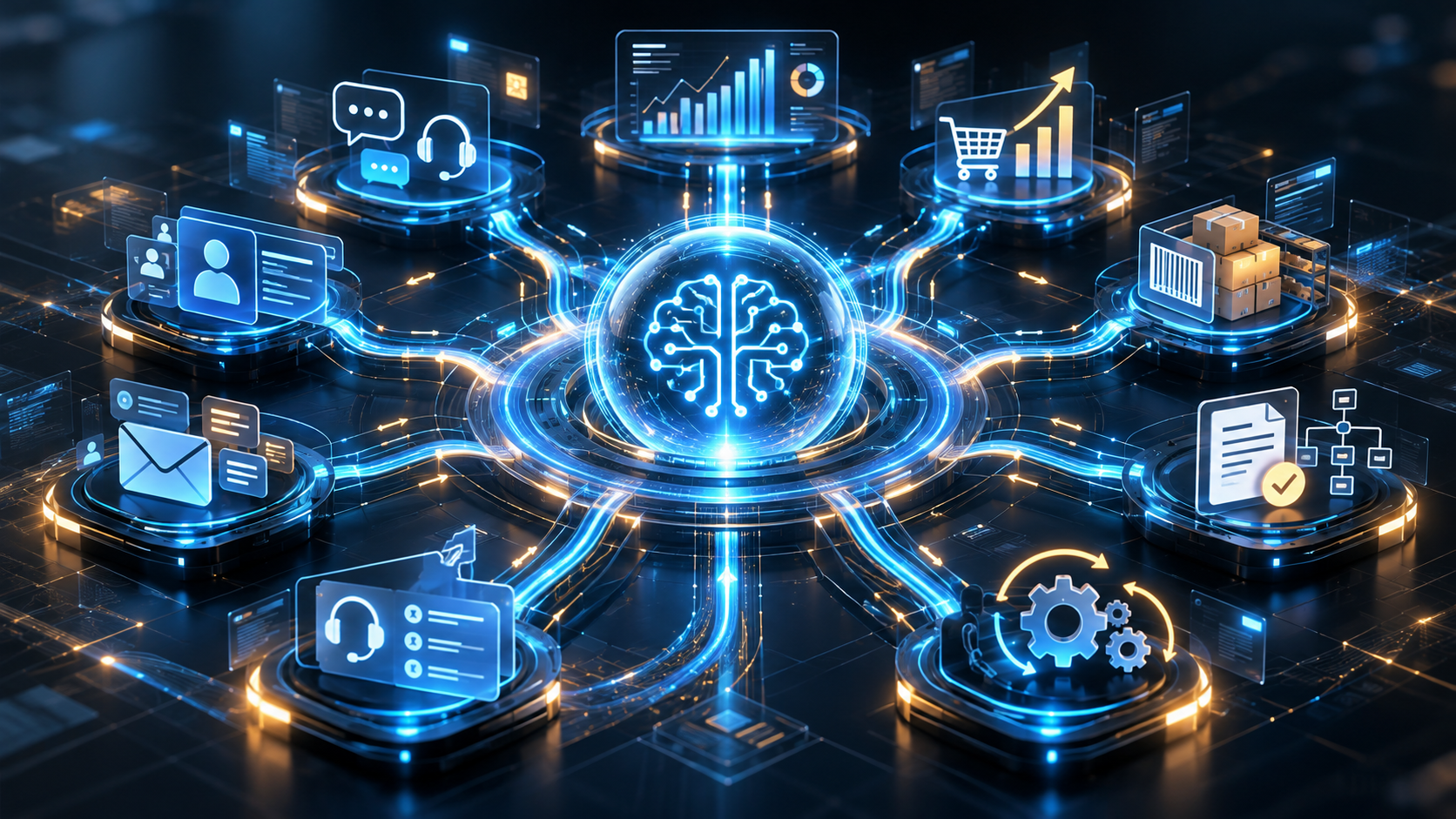
Generative AI is changing how businesses create content, analyze information, and develop software. Agentic AI extends those capabilities into workflows that can retrieve information, use tools, and take authorized actions toward a defined goal. This creates opportunities for businesses to automate complex processes, reduce manual work, and improve operational efficiency.

For businesses evaluating AI investments, the important question is not which technology sounds more advanced. It is whether employees need better information, automated execution, or a combination of both. Understanding that difference helps organizations avoid unnecessary integrations and identify where AI can produce measurable results.

Generative AI vs. Agentic AI: What Changes?

Gen AI vs. Agentic AI

Generative AI is primarily concerned with producing or transforming information: drafting documents, generating code, summarizing research, or analyzing supplied material. An employee usually directs the interaction and decides how to use the result.

Agentic AI is organized around an objective. An agent may break a request into steps, select tools, retrieve information, perform authorized actions, assess the outcome, and adjust its next step. It can coordinate a process rather than simply prepare material for someone else to use.

Generative AI and agentic AI are not entirely separate technologies. Many AI agents use generative models to interpret instructions, analyze results, and decide what step to take next. Conversely, a generative AI application with tool access may behave like an agent. The more useful distinction is what the overall system is designed and authorized to accomplish.

Generative AI vs. Agentic AI at a Glance

Capability Generative AI Agentic AI
Primary purpose Create and analyze information Complete goals through actions
Interaction Responds to prompts and requests Can plan and execute multiple steps
Tool usage May use connected tools Uses tools within coordinated workflows
Human role Reviews and applies outputs Supervises, approves, handles exceptions
Typical uses Writing, research, coding assistance Support, reporting, operational processes

How Agentic AI Works in Practice

Consider a sales director asking why a product line underperformed last quarter. A generative AI assistant could interpret figures supplied by the director and draft a report. An appropriately configured agent could take the broader goal, obtain sales records, compare inventory and pricing changes, investigate anomalies, and assemble evidence-backed findings.

The hardest part of deploying an agent is often not generating a plausible response but connecting it to accurate business data, reliable integrations, and accountable decisions. Building an effective AI agent therefore involves more than connecting a language model to business software. Several components need to work together:

  • Planning and orchestration: Decide which steps and tools to use, track progress, and handle unexpected results.
  • Integrations: Connect to approved systems such as CRMs, ERPs, databases, and reporting platforms.
  • Context and business rules: Understand relevant definitions, permissions, policies, and relationships between company data.
  • Evaluation and escalation: Check outcomes, detect uncertainty, and request human review when appropriate.

AI agents can operate through a repeating cycle of planning, executing actions, evaluating results, and adjusting their approach based on new information. For example, an agent might identify falling sales but recommend the wrong response if it confuses stock on hand with inventory already reserved for orders. Mapping business definitions and validating results are therefore essential parts of engineering reliable workflows.

Where Generative AI Delivers Business Value

Generative AI works well when employees need faster ways to produce, interpret, or refine information. Common applications include first drafts of communications, document summaries, research assistance, technical documentation, design concepts, and software development support.

In software engineering, AI assistants can suggest functions, explain unfamiliar code, propose tests, and help developers explore implementation options. These contributions can speed up portions of the work, but they do not replace architectural judgment, security reviews, or systematic testing. Code that appears convincing can still contain defects or fail to meet business requirements.

Generative AI also tends to be a practical starting point for organizations that want employee assistance without granting an AI system permission to make changes across operational tools. Its value can be substantial even when a person remains responsible for every final action.

Where Agentic AI Changes Business Operations

Agentic AI for Business Operations

Agentic AI becomes relevant when work requires several dependent decisions across software systems. The biggest opportunity is often the handoff between tasks: retrieving data, identifying exceptions, routing approvals, and keeping records consistent. Those handoffs should be measured before they are automated.

Customer Service

Consider an online retailer handling hundreds of inquiries about delayed shipments. With generative AI, a service representative could supply order details and request a draft response. An authorized AI agent could go further: retrieve the order, check shipment tracking, compare the delivery address, consult replacement policies, and prepare the next action. Under carefully defined rules, it might complete a routine update automatically while sending disputed transactions, refunds, or costly replacements to an employee for approval. This is an illustrative workflow, not a claim that an off-the-shelf agent can perform every step.

Sales and Operations

An agent might assemble account history, identify follow-up opportunities, and prepare CRM updates. Another could investigate inventory shortages by checking warehouse quantities, open purchase orders, and historical demand. Success depends on consistent business definitions and reliable connections to live systems.

Reporting and Internal Support

Agents can be designed to pull information from separate tools, reconcile discrepancies, produce management reports, or guide approved IT troubleshooting procedures. In more complex processes, several specialized agents may divide the work. Multi-agent architectures are useful in some cases, but introduce additional coordination, latency, and operating costs.

When Should a Business Use Agentic AI Instead of Generative AI?

Start with the workflow, not the technology. If employees need help writing, researching, analyzing, or coding, a generative AI assistant may solve the problem with fewer moving parts. If a process requires retrieving data, choosing among actions, and updating connected systems, an agentic approach may be worth evaluating.

A practical assessment should address four questions:

  • What outcome matters? Define a measurable result, such as faster case resolution or fewer manual handoffs.
  • What information is required? Identify source systems, data quality issues, and business definitions the system must understand.
  • What actions are permitted? Set access rights, approval checkpoints, and escalation rules before deployment.
  • What happens when it fails? Plan for inaccurate outputs, unavailable systems, unexpected inputs, monitoring, and recovery.

Not every process needs an autonomous agent. Predictable tasks often belong in conventional automation, with AI reserved for interpreting ambiguous inputs or investigating exceptions. Repeated model calls, API requests, and result checks can make an agent slower and more expensive than a simpler workflow. Design for the least autonomy that achieves the desired result.

Reliability, Security, and Human Oversight

Greater autonomy increases the consequences of poorly designed integrations. A generated paragraph can be corrected before publication; an unauthorized change to customer records or a mistaken financial transaction can have immediate operational effects.

Production systems need scoped permissions, reliable data, audit logs, testing, monitoring, and clear ownership. Human approval is often appropriate for high-impact actions, while lower-risk tasks can operate within predefined rules. The NIST AI Risk Management Framework offers a useful foundation for evaluating reliability, security, and accountability.

Teams should also evaluate agent performance after deployment. Accuracy, task-completion rates, intervention frequency, operating cost, and user experience can reveal whether automation is producing meaningful benefits or simply moving work into a different system.

The Direction of Business AI

Generative and agentic capabilities will increasingly appear together inside business applications. Employees may request an analysis, review an agent’s proposed plan, authorize selected actions, and receive a report showing what was completed. The division of labor will depend on the risks and complexity of each process.

Businesses should judge AI by completed work, error rates, and the cost of human intervention—not by the number of decisions an agent makes independently. A narrowly scoped agent that reliably resolves routine cases may create more value than an ambitious system that frequently needs correction.

Choosing AI That Delivers Business Value

The decision should begin with a specific business outcome. Identify the information employees need, the actions a system may safely take, and the evidence required to judge its performance. A successful implementation reliably improves the workflow, with clear ownership of the results.