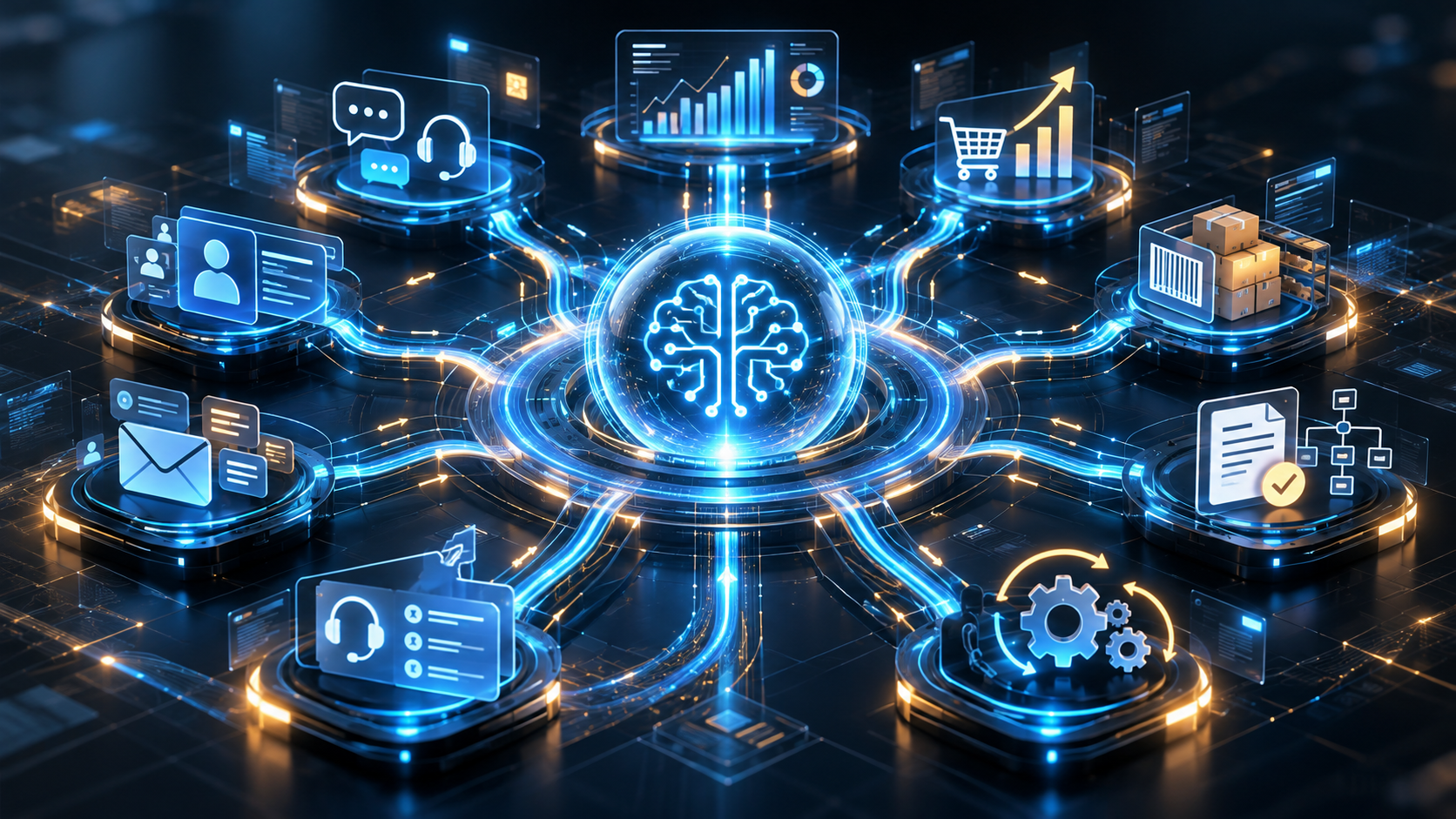

Not every AI agent makes decisions the same way. Some react to predefined conditions, others maintain context, plan toward objectives, weigh competing outcomes, or adapt through feedback. Modern applications may also coordinate several specialized agents. Understanding these architectural distinctions helps businesses choose systems that fit their tasks without adding unnecessary complexity.
The five traditional types of AI agents describe how a system selects actions. Single-agent and multi-agent architectures answer a different question: how many decision-making components participate and how they coordinate. These classifications overlap rather than representing mutually exclusive products.
The Five Foundational Types of AI Agents
1. Simple Reflex Agents
Simple reflex agents respond to current inputs using predefined condition-action rules. They have no internal memory of earlier states. A basic temperature controller, for instance, may activate heating when a threshold is crossed. This approach is predictable and inexpensive, but it cannot reason about missing context or unfamiliar conditions.
In enterprise software, rule-driven automation can provide similar behavior, though not every rule-based workflow is marketed as an AI agent. When decisions are straightforward, a simple system is often more reliable than a language model interpreting the same rules.
2. Model-Based Reflex Agents
Model-based reflex agents maintain an internal representation of the environment. They combine current observations with remembered state to act when all relevant information is not visible at once. A warehouse robot might track which aisles it has visited or where it encountered obstacles instead of responding to each sensor reading in isolation.
The architecture depends on an accurate state model. If updates are incomplete or delayed, subsequent decisions can be wrong even when the rules themselves are sound.
3. Goal-Based Agents
Goal-based agents evaluate possible actions according to whether they move the system toward a defined objective. Instead of following one fixed response to an input, an agent may select or revise a sequence of steps. An automated planning system, for example, might identify an available route through a warehouse and adjust when a passage becomes blocked.
Goal pursuit does not imply unlimited autonomy. The agent still operates within the actions, information, and policies its developers make available. A clear objective must be accompanied by constraints on how it can be achieved.
4. Utility-Based Agents
A goal may have several acceptable solutions. Utility-based agents evaluate alternatives using a function that represents preferred trade-offs, such as cost, time, energy consumption, or risk. In a logistics system, two routes might both deliver on time, but one may require more fuel or create greater scheduling disruption.
Utility functions make trade-offs explicit, but designing them is difficult. If the scoring criteria omit safety, service quality, or other important factors, the system can optimize a metric while producing a poor operational outcome.
5. Learning Agents
Learning agents change their behavior using experience or feedback. They may update a policy, predictive model, or decision strategy as new evidence becomes available. For example, an adaptive scheduling system might refine forecasts using observed demand and subsequent outcomes.
This differs from an LLM agent remembering earlier messages: task context or plan revision does not necessarily update the underlying model. Production learning also requires evaluation, monitoring, and safeguards against deterioration.
The following table summarizes the defining capabilities and illustrative applications of each agent type.
| Agent type | Defining capability | Illustrative application |
|---|---|---|
| Simple reflex | Follows condition-action rules | Temperature controller |
| Model-based reflex | Maintains internal state | Warehouse navigation |
| Goal-based | Plans toward a defined goal | Route planning |
| Utility-based | Weighs competing outcomes | Logistics optimization |
| Learning | Adapts from feedback | Demand-based scheduling |
How Modern LLM Agents Fit These Categories

The five-part taxonomy predates today’s LLM-based agents. A language-model agent may combine goal-directed planning, temporary task memory, retrieval, tool calls, and evaluations within one application. Some systems also use fixed rules for high-risk actions or external scoring functions to choose among alternatives.
Consequently, product labels such as coding agent, research agent, or customer-service agent describe what a system does, not a separate foundational decision architecture. The practical design questions are what information the agent can access, how it selects actions, and when it must ask for approval.
Single-Agent vs. Multi-Agent Systems
A single-agent system puts the main planning and action-selection responsibility in one component. That component may call databases, APIs, and deterministic services without becoming a multi-agent system. This is often a sensible starting point because tracing decisions, controlling permissions, and evaluating results are more straightforward.
A multi-agent system separates responsibilities across agents that may have different instructions, tools, or access boundaries. Consider a business handling complex customer service requests. One agent could interpret the issue, a second retrieve approved account records and documentation, and a third check the proposed resolution against company policy. A coordinating component could assemble their findings for an employee to approve. Distinct roles can be evaluated separately, but each handoff adds processing time, expense, and possible communication failures. For simpler requests, one agent using the same approved tools may be sufficient.
Common Multi-Agent Coordination Patterns
Multi-agent designs can be described along several dimensions. Sequential and parallel workflows describe when tasks execute; hierarchical and distributed designs describe how decisions are coordinated; and homogeneous and heterogeneous teams describe whether agents share similar capabilities or have distinct roles. A single system may combine these characteristics, such as a hierarchical coordinator managing heterogeneous specialists in parallel.
Sequential and Parallel Workflows
In sequential orchestration, one agent completes a stage before handing its output to the next. A research agent might assemble evidence before a drafting agent prepares a report. In parallel orchestration, agents work on independent subtasks at the same time, such as analyzing separate document collections before their findings are combined.
Sequential designs simplify dependencies but may introduce delay. Parallel designs can shorten elapsed time when subtasks are truly independent, though combining inconsistent results can create new review work.
Hierarchical and Distributed Coordination
A hierarchical design uses a coordinating agent or controller to delegate tasks, assess progress, and assemble results from specialists. It offers a clear place for overall task ownership, but that coordinator can become a bottleneck or single point of failure.
In a distributed design, agents exchange messages or hand off control without relying on one manager for every decision. This can support flexible collaboration, but shared state, conflicting instructions, and responsibility for the final result become harder to manage. Frameworks may also support group conversations or context-based handoffs as specific orchestration patterns.
Homogeneous and Heterogeneous Agent Teams
Homogeneous systems use agents with similar models and capabilities, sometimes assigning the same process to separate cases or subtasks. Heterogeneous systems combine agents with different tools, models, responsibilities, or access levels. A document workflow might pair a low-cost classification agent with a specialist that performs more demanding analysis.
The value of specialization must outweigh communication overhead and operating costs.
The Engineering Challenges of Multi-Agent Systems
Coordination creates failure modes that a successful single-agent demonstration may not reveal. Agents can pass along unsupported assumptions, disagree about document versions, repeat tool calls, or wait indefinitely for another component. Each handoff needs an explicit contract describing the expected inputs, outputs, error conditions, and responsible owner.
A mistake early in a multi-agent workflow can influence every subsequent decision. For example, an agent may retrieve outdated policy information, another may draft an answer based on it, and a reviewer agent may miss the original problem. Validate evidence at critical handoffs, retain source references, and establish procedures for retries or human escalation.
Important safeguards include scoped credentials, timeouts, limits on tool use, reliable state tracking, and approval before consequential actions. Developers should test not only whether an individual agent performs well but whether the entire chain produces correct, authorized results. Logs must make it possible to reconstruct which component made a decision and what evidence it used.
Microsoft’s Agent Framework describes sequential, concurrent, handoff, group-chat, and manager-coordinated orchestration patterns. These patterns are implementation options, not evidence that every workflow benefits from multiple agents.
Choosing the Right Agent Architecture

Start with the simplest design that meets the operational requirement. Fixed rules can handle predictable inputs; an agent with task context may be enough for variable information requests. Add planning when a process genuinely involves dependent steps, and introduce explicit utility trade-offs only when relevant objectives compete. Learning should be considered when there is a reliable feedback signal and a controlled way to evaluate changes.
Before creating multiple agents, test whether a single well-scoped agent with dependable tools can complete the task. Split responsibilities when there are clear gains from parallel execution, distinct specialist capabilities, separate security permissions, or independent evaluation. Measure end-to-end accuracy, latency, cost, recoverability, and human review effort rather than merely counting agent-to-agent interactions.
| Business requirement | Architecture to consider |
|---|---|
| Predictable rules | Conventional automation or reflex logic |
| Context-dependent decisions | State-aware agent or LLM-based system |
| Dependent multistep goals | Goal-based planning |
| Cost, time, and risk trade-offs | Utility-based decision-making |
| Independent specialist tasks | Parallel multi-agent workflow |
| Dependent specialist tasks | Sequential multi-agent workflow |
| Multiple dependent agent roles | Hierarchical or distributed orchestration |
Agent architecture is ultimately a design choice, not a measure of sophistication. The strongest system is one whose decision process, coordination, and oversight match the work it is authorized to perform.