
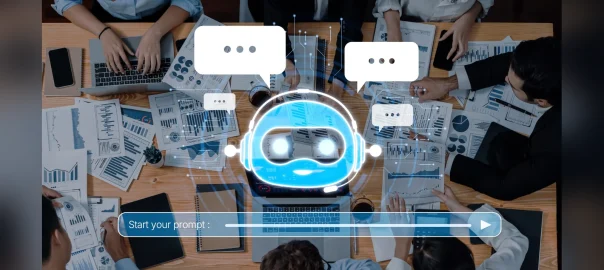
A business employee asks an AI assistant how to organize a complex customer handoff. The assistant suggests a checklist, drafts an email, and explains the next steps. The employee still has to open the customer record, update the project system, assign responsibilities, and send the message. AI helped with thinking, but the work remained manual.
Actionable AI changes that division of labor. With approved tools and permissions, an agent may move from recommending steps to carrying out selected ones. For organizations, this shift creates opportunities to redesign work across systems. It also makes questions about authority, verification, and accountability more important.
From Answers to Outcomes
Conversational AI helps people explore ideas, answer questions, and prepare drafts. Actionable AI extends those interactions into workflows that retrieve records, prepare updates, create tasks, or request approvals. These are not mutually exclusive technologies: a conversational assistant can become action-capable through approved tools and integrations. The distinction is what the system is authorized to do beyond generating a response.
An assistant might explain how to schedule a meeting. An authorized agent could check availability, propose times, create an event, and confirm the outcome. Each step requires application access and clear permissions.
An MIT Professional Education presentation by Abel Sanchez and John R. Williams illustrates the shift from conversational advice to AI systems executing defined tasks. Its demonstrations show guided use of tools, not guaranteed reliability across applications.
What Makes an AI System Actionable?
Access to the Right Tools
A model cannot update a business system merely by describing an update. It needs a permitted connection, such as an application programming interface, a business-software action, or a controlled computer-use environment. Tools translate an intended action into an operation that another system can accept.
OpenAI’s Agents SDK documentation describes agents that can use tools and maintain context across steps. This is one technical approach, not a requirement that every organization use the same platform. The important design question is which systems the agent needs to reach and which operations should remain unavailable.
Context and Task Boundaries
An agent needs the relevant customer, workflow, policies, and definition of completion. Its context may come from authorized but incomplete or outdated records.
A request such as “follow up on overdue proposals” is too vague for unrestricted execution. An operational version would specify which proposals qualify, which account owner approves outreach, which message template to use, and how the completed action is recorded.
Feedback and Verification
A tool response alone may not prove that a business action succeeded. The agent or surrounding software should verify the saved record and stop when the outcome is unclear.
That requirement becomes especially important when actions are irreversible or visible to customers. A drafted email can be reviewed. A sent email, canceled reservation, or changed invoice creates consequences that cannot necessarily be reversed by another prompt.
Where the Shift Could Change Everyday Operations
Customer Service and Account Management
Consider a hypothetical customer service team receiving questions about order delays. A conversational assistant could explain the support policy or suggest a response. An action-capable system could additionally look up the approved order record, prepare a case, and propose the appropriate next step for an employee.
Routine case creation may be authorized, but refunds or delivery promises may require approval. Incorrect information must be caught before it reaches customers.
Meeting Follow-Up and Internal Coordination
Meetings often produce decisions that must become work in other systems. An AI assistant can summarize notes and identify possible action items. Connected to an approved project-management platform, an agent may prepare tasks, suggest owners, and attach relevant context. For example, a follow-up workflow could link each proposed task to the original meeting notes, check whether the task already exists, and show participants what will be recorded before requesting approval. After the task is created, the workflow should confirm its saved owner and due date.
Ambiguous ownership and conflicting deadlines should go to participants for confirmation.
Sales Operations and Research
A sales team might ask for a summary of prospects that have not received follow-up. Conversational AI can analyze a provided list. An agent with authorized CRM access might retrieve current records, flag missing information, and draft follow-up activities. Sending messages or changing deal stages could require a salesperson’s review.
The system should not invent contact details, make unsupported claims, or disregard communication preferences.
Moving From a Prompt to a Business Process

A successful deployment starts by defining the trigger, required information, permitted actions, output, and exceptions. Broader autonomy will not resolve an ambiguous process.
For example, an operations team might specify that a new service request can trigger a draft work order only after the customer record has been matched and required fields are complete. Missing information should route the request to an employee, not be invented. A completed draft should be linked to its originating request for later review.
Next, choose the tool boundaries. Reading records generally presents different risks from editing them. Creating a draft is different from publishing a message or issuing a payment. Separating those permissions lets teams introduce useful actions without granting the agent control over an entire application.
Design clear completion states: attempted, completed, or needs review. Assign each state an owner and a next step so unresolved requests do not disappear between teams.
Why Human Oversight Still Matters
Actionability creates a new risk: mistakes can leave the chat window and affect real data. An agent might select the wrong customer, misinterpret a policy, or follow an instruction embedded in a document that was never meant to control it. Prompt injection is especially relevant when agents read webpages, messages, or files while using privileged tools.
Approvals are one control, but not the only one. Organizations also need limited permissions, validation of tool inputs, logs of consequential actions, and clear stopping conditions. OpenAI’s guidance for agent guardrails and human review describes mechanisms for checking outputs or tool behavior and pausing before sensitive actions.
The right amount of oversight varies by workflow. Preparing a draft internal task may need only periodic sampling. Changing an account balance or sending a contractual notice may require explicit authorization. Controls should reflect the impact of an error, not merely the sophistication of the model.
The Strategic Opportunity Is Workflow Design
It is tempting to see actionable AI as an upgraded chat interface. The larger opportunity is to examine where work stalls between people and software. Employees may know what needs to happen but lose time collecting information, copying it between systems, and checking that every handoff occurred.
Action-capable AI can support those transitions, but it should not replace reliable integrations that already accomplish the task. A sensible architecture may use conventional software for structured transactions and AI for interpreting requests or preparing decisions. This is a software design problem as much as an AI selection problem.
For a business evaluating AI development, the first project should be narrow enough to observe end to end. Identify the users, the systems involved, the expected result, and the cost of human review. Establish a baseline for processing time and error rates before introducing an agent.
An initial implementation might have the agent gather information and prepare an action for approval. Employees then shift from performing every routine step to reviewing proposed actions, resolving exceptions, and improving the process. Managers should define who approves work, who handles escalations, and who maintains the workflow. As the team gains evidence of dependable performance, it can automate additional low-risk steps without treating autonomy as the goal.
Measuring Whether Actionable AI Delivers Value

A convincing demonstration shows an agent completing a task once. A dependable business process performs across different cases, permissions, and changing conditions. Evaluation should include ordinary records, missing fields, conflicting information, expired sessions, and failures in connected applications.
Measure completion rates, time saved after review, employee interventions, correction effort, and error severity. Compare those results with the original process and include oversight costs. Faster execution that creates more reconciliation work may not improve productivity.
After launch, teams still need to monitor results, review exceptions, and update integrations. Include this operational work in the business case.
Final Thoughts
The shift from conversational to actionable AI changes how employees work with business software. Instead of using an assistant only to determine the next step, teams can delegate defined actions within controlled workflows.
The opportunity is not to remove people from the process. It is to reduce routine handoffs while enabling employees to supervise completed work, resolve exceptions, and retain control over consequential decisions. Reliable integrations, clear ownership, and measurable results make that transition sustainable.